




Singapore to invest S$37 billion in research, innovation and enterprise over next 5 years: NRF
Singapore's investment is a small fraction of what the whole world invests, said National Research Foundation chairman Heng Swee Keat.
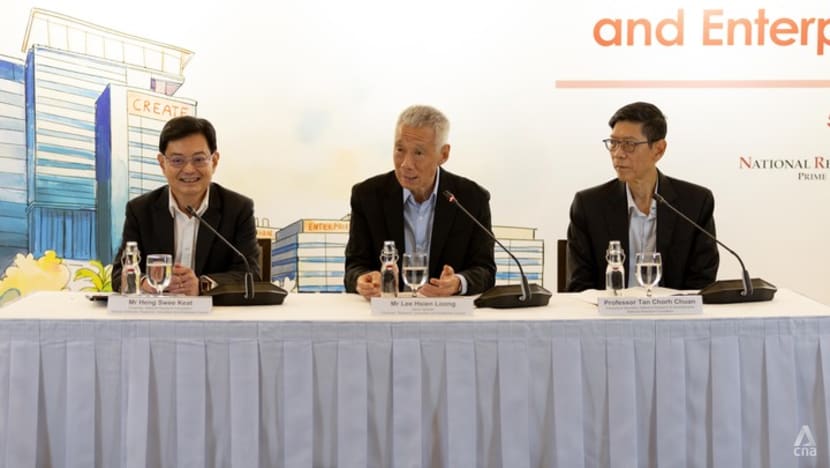
(From left) National Research Foundation chairman Heng Swee Keat, Senior Minister Lee Hsien Loong and Professor Tan Chorh Chuan, permanent secretary of National Research and Development, during a press conference at Shangri-La hotel on Dec 5, 2025. (Photo: CNA/Ili Mansor)

This audio is generated by an AI tool.


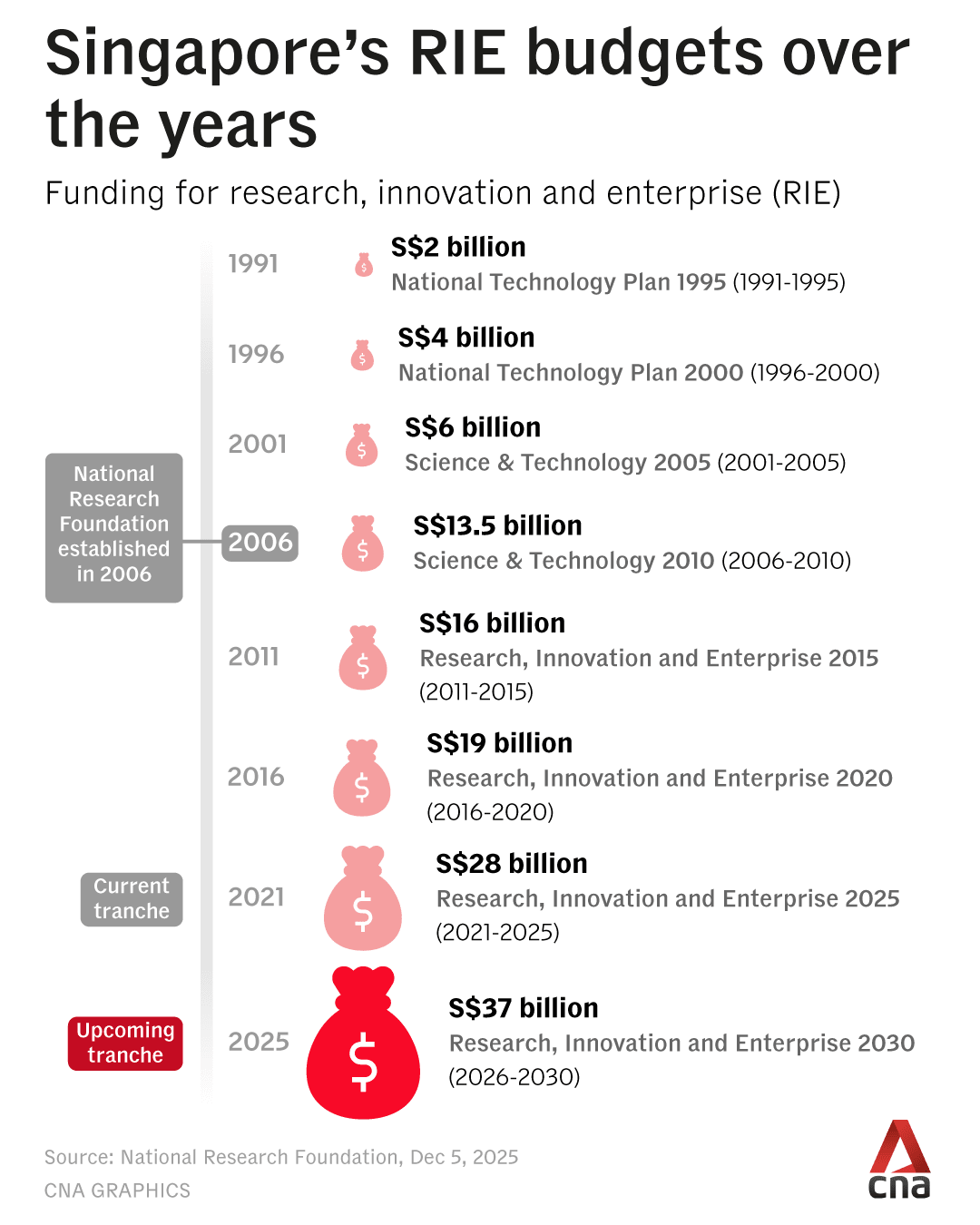
SINGAPORE: Singapore will invest S$37 billion (US$28.5 billion) – or about 1 per cent of its economic output – on research, innovation and enterprise over the next five years, announced the National Research Foundation (NRF) on Friday (Dec 5).
Of the total sum, 8 per cent – or S$3 billion – will go towards research, innovation and enterprise in flagships and “grand challenges�, including the semiconductor industry and longevity research.
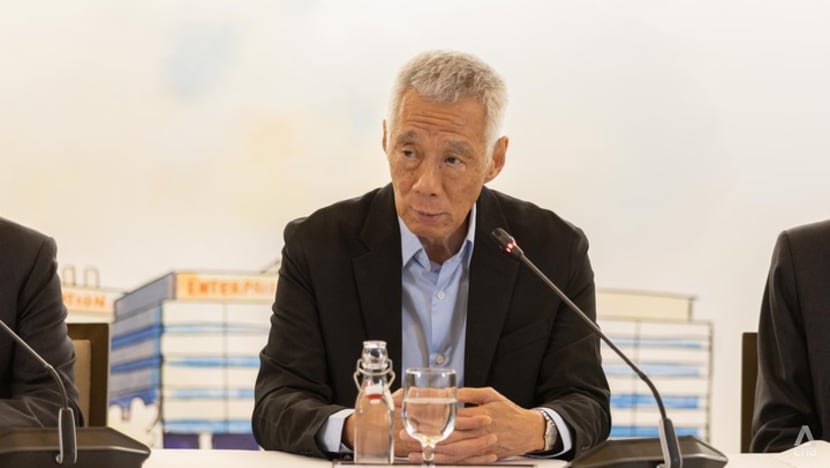
Speaking at the press conference announcing the next tranche of the research, innovation and enterprise budget, Senior Minister Lee Hsien Loong noted that Singapore will maintain its investment of about 1 per cent of its GDP in these areas.
The flagships and grand challenges will be large national programmes with a strong mission focus, he added.
"Each national programme will develop a coordinated portfolio of research projects to address major challenges in one single important sector or area," said Mr Lee.
"This will help to focus our efforts and our attention, and create more value and impact."
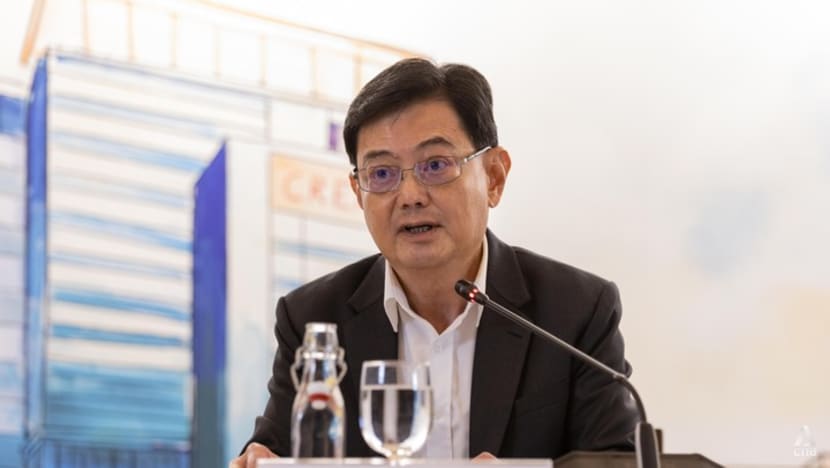
The idea of flagships and grand challenges was first announced by NRF chairman Heng Swee Keat in parliament in February, when he was the Deputy Prime Minister. He has since stepped down from politics in the last General Election.
The flagships will "push for value creation" in key economic sectors and the grand challenges will address national strategic priorities, he said at the time.
Aside from longevity research and semiconductors, there will be another flagship and grand challenge, which have yet to be announced.
Speaking at the press conference, Mr Heng said that while what Singapore is investing in research, innovation and enterprise is significant, it is "a small fraction of what the whole world invests".
"So it is critical for us to collaborate strategically, to partner with the best institutions and industry here and abroad," he added.
Singapore is committed to investing about 1 per cent of its GDP in research, innovation and enterprise, NRF noted. The country spent S$28 billion in this area from 2021 to 2025, S$3 billion more than initially projected. The additional funds came from a mid-term top-up.
Over the next five years, Singapore will strengthen and expand collaborations with leading researchers and institutions around the world, said NRF in a press release on Friday.
The foundation will also establish the Singapore-Horizon Europe Complementary Fund to promote collaborations with Horizon Europe, the European Union's flagship funding programme for research and innovation, it added.
This fund will provide financial support to eligible Singapore-based researchers participating in Horizon Europe projects that have received grants in "priority areas" for Singapore.
The research, innovation and enterprise budget from 2021 to 2025 covered four domains – manufacturing, trade and connectivity, human health and potential, urban solutions and sustainability, as well as smart nation and digital economy.
It also addressed academic research, manpower, and innovation and enterprise needs.
The 2026 to 2030 edition tranche will look at the same four domains, on top of growing and enhancing Singapore’s talent pool, and leveraging artificial intelligence as a transformative force, NRF said.
New funding schemes will also be introduced to develop and attract promising young research and entrepreneurial talent, it added.
NRF will also introduce a new postdoctoral award, which will support high-potential postdoctoral talents with a S$250,000 research grant and up to four years of salary support, it said in a separate factsheet.
"This will give young talent an attractive opportunity to pursue independent research while allowing institutions to assess their suitability for faculty roles," said NRF.
There will also be new programmes for trained researchers to gain entrepreneurial experience in deep tech start-ups abroad, it added.
For example, the Activate Global-Singapore Fellowship – which will support Singapore-based scientists and engineers with early-stage deep tech innovations – will open applications in 2026.
Leveraging AI as a "transformative force" over the next five years, Singapore also plans to develop local AI research talent and implement AI to accelerate research in the four domains.
The next tranche of funding will also be used to build peaks of fundamental AI research, including responsible AI and emerging AI, NRF said.

FOCUS AREAS
In terms of focusing research on the semiconductor industry, NRF aims to establish Singapore as a strategically important research and development node, anchor high-value manufacturing activities locally and create new pathways for deep-tech startups and globally competitive local enterprises.
Singapore currently accounts for 10 per cent of worldwide chip production and 20 per cent of global semiconductor manufacturing equipment production, said NRF in a separate fact sheet.
When asked about his thoughts about the speculative AI bubble and how this flagship has factored in that risk, Mr Lee said he did not know if there is an AI bubble, noting that there are mixed opinions on the matter.
"The thing with bubbles is that you only know afterwards that there was one, and sometimes even afterwards, you are not sure," he added.
Whether or not there is an AI bubble, electronics is a very important part of Singapore's economy and the global economy, said Mr Lee, who is also chair of the Research, Innovation and Enterprise Council.
"You need electronics for all kinds of things, and we are a significant electronics player, producer, semiconductors. And I think that we need to upgrade that, and what we're doing will work towards that."
As for the grand challenges, one will tackle maximising healthy and successful longevity, said NRF.
Ageing is one of the most pressing challenges in Singapore, said NRF noting that one in four Singaporeans are projected to be aged 65 and above by 2030.
In Singapore, about half of adults aged 85 and above live with dementia, and more than 150,000 Singaporeans are projected to live with dementia by 2030.
In addition, frailty and musculoskeletal disorders account for about 20.7 per cent of years lived with disability in Singapore.
Through this grand challenge, Singapore will develop and manage a portfolio of research meant to address key scientific knowledge gaps to inform interventions, with a focus on maintaining brain health and physical function as people age, said NRF.
An ageing cohort and data infrastructure will be established to enable new basic and translational research, and a testbed for healthy ageing solutions will be set up to validate research insights.
PROGRESS SO FAR
Singapore's investment in research, innovation and enterprise over the last five years have yielded a more research and development intensive economy as well as a growing deep tech ecosystem, said NRF in the press release.
Business expenditure on research and development rose to S$8.1 billion in 2022 from S$4.2 billion in 2012, with the number of industry researchers also increasing by 25 per cent in the same period.
In the past five years, Singapore's deep tech startups have attracted US$1 billion and above of venture capital funding each year, which accounts for 20 per cent of total venture capital investments in Singapore, NRF noted.
Deep tech refers to technologies built on significant scientific or engineering breakthroughs, such as innovations in AI, advanced materials and biotechnology.
Overall, venture capital investments rose to US$6.1 billion in 2023 from US$4.1 billion in 2020, reflecting the "growing commercial potential" of Singapore-based startups, said the foundation in the press release.
When asked if Singapore may commit a larger proportion of its GDP to investing in research, innovation and enterprise, Mr Heng noted that the country is also hoping to invite more private sector investments in the area.
The government has had "many discussions" with companies about what they need about what researchers are doing, to better understand the industries' needs, he added.
"This very symbiotic relationship between researchers and companies is a strength, and therefore, what we must seek to do is not just increase the amount of funding ... but to use it really well to make an impact."
Singapore is not planning on increasing the 1 per cent commitment now, but is also not "constrained" by the figure, said Mr Lee.
Investing in research and development should be done on a sustained, long-term basis, he stressed. "It's not something where you want feast and famine, where I have a big budget surplus, I spend more this year, next year, I'm tight on money, I cut back my projects," he added.
Research projects last for years and researchers need the confidence that their funding will not be cut suddenly, sending years of work down the drain, said Mr Lee.
"We've decided we will keep it stable at about 1 per cent. It's not small, it's not exorbitant, but it's a significant contribution."
Within that figure, Singapore will find projects that are "scientifically valuable" and relevant to the country. While some projects may be broader, basic research, it has to be "good science" that is "worthwhile" to spend on, he added.


